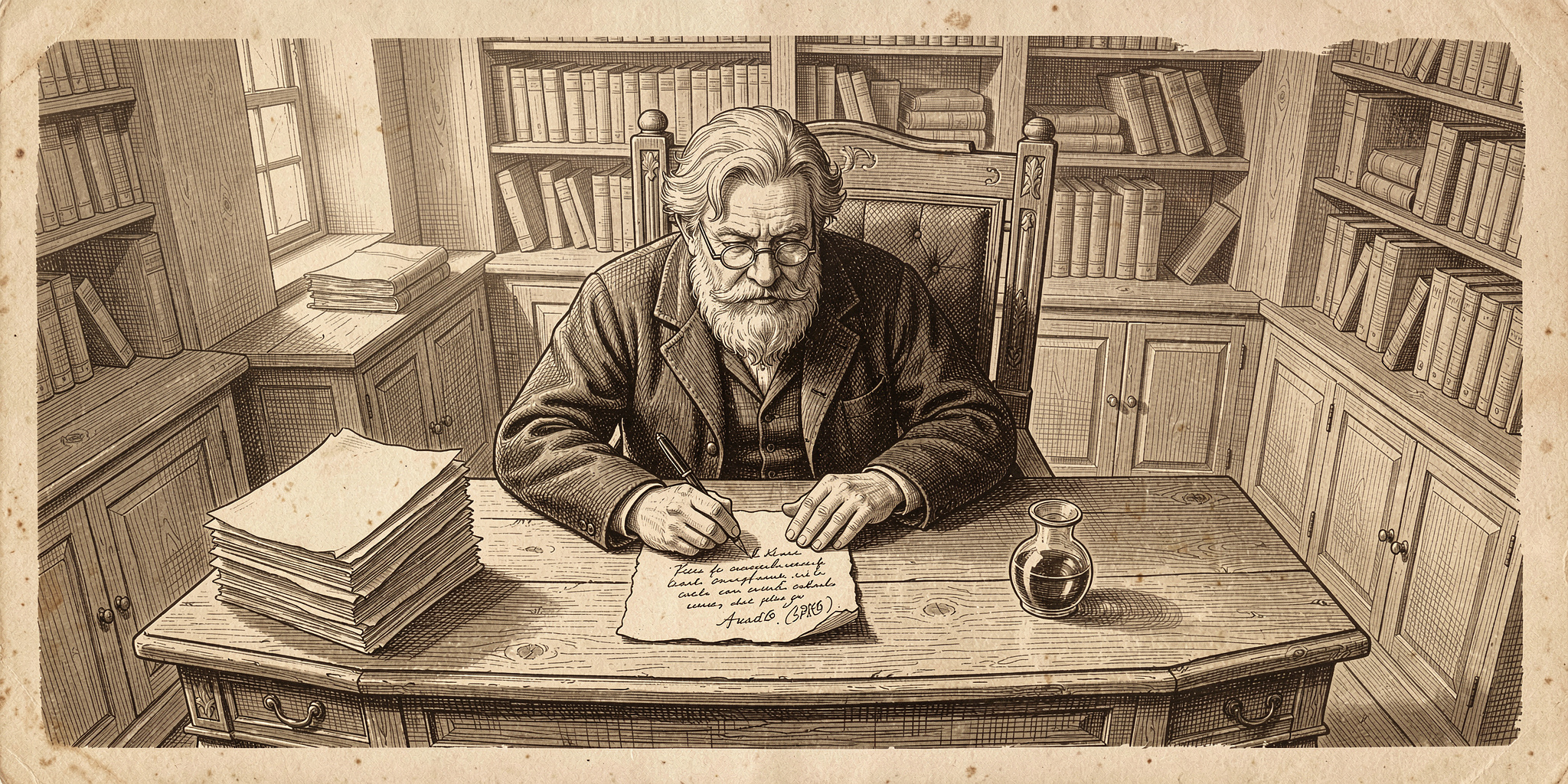
I was listening to a podcast on Henry Hazlitt (1894-1993) and they mentioned his book on Will Power.
https://archive.org/stream/way-to-will-power-the-hazlitt-henry-1894-1993/way%20to%20will-power%2C%20The%20-%20Hazlitt%2C%20Henry%2C%201894-1993_djvu.txt
The style was too 18th century for me so i guided Qwen3.8 through an analysis of it until I felt it got it right, This is the tl;dr of a book many people felt was important.
Your tl;dr;tl;dr is:
Will-Power is the ability to keep a remote
desire so vividly in mind that it overrides competing immediate
desires. It is the capacity to willingly pay the "price" of future
advantage by sacrificing present comfort.
----------------------------------
Henry Hazlitt’s The Way to Will Power (1922) is a rigorously heterodox treatise that dismantles popular, mystical conceptions of "willpower" and replaces them with a precise, desire-based model of human action. Written decades before the rise of modern therapeutic culture or systemic determinism, Hazlitt’s work operates firmly within the tradition of classical psychology and moral philosophy. It demands personal responsibility, intellectual honesty, and a clear-eyed assessment of human nature, eschewing both soft determinism and the excuse-making that characterizes much contemporary self-help literature.
Below is a precise, analytic exposition of the text’s core arguments, followed by a critique of its internal tensions and limitations.
---
### I. The Dissolution of the Will and the Intellect as Valet
Hazlitt opens with a deliberately provocative thesis: "The will does not exist." He argues that the popular conception of the will as a distinct, homunculus-like faculty residing in the mind is a grotesque fallacy. There is no separate "will" that can be flexed like a muscle. Instead, what we call "the will" is merely a convenient linguistic label for whichever desire currently holds temporary supremacy in the mind.
Consequently, Hazlitt demotes the intellect from its traditional pedestal. The intellect is not the master of human action; it is a "valet" or a steering gear. Desires are the engine. The intellect’s sole function is to calculate the most efficient means to achieve the ends dictated by the strongest prevailing desire. Even the act of thinking itself, Hazlitt notes, arises only from thwarted desires; without a purpose to fulfill, the intellect remains dormant. When a person resolves to "let the intellect be master," they are merely experiencing a temporary victory of their desire for rationality over their desire for immediate gratification.
### II. The Mechanics of Volition: Price, Character, and Habit
Having dissolved the mystical "will," Hazlitt reconstructs "will-power" in practical, economic terms. Will-power is defined as the ability to keep a remote desire so vividly in mind that it overrides competing immediate desires. It is the capacity to willingly pay the "price" of future advantage by sacrificing present comfort.
This framework leads to Hazlitt’s conception of character. If the will is merely the prevailing desire, then true will-power is the sustained "desire to be a certain sort of character." This requires two conditions: the ideals must be genuinely high, and they must be self-chosen, not merely adopted through social conformity or docility. Drawing on John Stuart Mill, Hazlitt argues that a strong character is not one devoid of impulses, but one whose "conscience" (the aggregate of counter-desires for long-term good) is strong enough to master vigorous, energetic impulses. A man who refrains from vice merely because he lacks the passion for it has no character; true moral worth lies in the inward struggle and victory.
Hazlitt further grounds this in the mechanics of habit and concentration. He rejects the notion that will-power is only tested in rare, heroic moments. Instead, it is exercised daily in mundane choices: facing unpleasant interviews, saying "no" to parasitic demands, and maintaining routine disciplines.
### III. The Physiology of Effort and Moral Courage
In the latter chapters, Hazlitt integrates William James’s concept of the "second wind" and "efficiency-equilibrium." He argues that what we perceive as physical or mental fatigue is often a psychological barrier rather than a true biological limit. The human organism possesses deep, untapped reserves of energy. The primary catalyst for accessing these reserves is not brute force, but intensity of interest.
When interest is sufficiently intense, "work" transforms into "play," and fatigue is postponed or ignored. Hazlitt illustrates this with historical geniuses (Darwin, Edison, Beethoven) whose prodigious output was not the result of grim, dogged endurance, but of an overwhelming, passionate absorption in their subjects. The practical lesson is that one must cultivate and sustain interest, diversify tasks to prevent flagging attention, and, when necessary, push through the initial "fatigue obstacle" by sheer volitional effort, trusting that a new level of energy will emerge.
The treatise culminates in the concept of moral courage. Will-power is not stubbornness, domineering behavior, or noise. It is the quiet, resolute courage to follow where reason leads, regardless of social opprobrium, unpopularity, or the fear of standing alone.
---
### IV. Critique of Contradictions and Weaknesses
Despite its analytic clarity and bracing tone, Hazlitt’s treatise contains several philosophical tensions and empirical blind spots.
1. The Homunculus Problem and Infinite Regress
Hazlitt vigorously denies the existence of a sovereign "self" or "will," reducing the individual to a "bundle of desires" where the strongest wins. Yet, he simultaneously exhorts the reader to cultivate the "desire to be a certain sort of character" and to choose "high ideals." This raises a critical question: If all desires are merely competing impulses, what mechanism selects which desire shall become the dominant "character" desire? If the intellect is merely a valet, it cannot independently elevate one desire over another without already being directed by a higher-order desire. This leads to an infinite regress. Hazlitt’s model flirts with hard psychological determinism, which undermines his normative exhortations to take responsibility for shaping one’s own character.
2. The Underestimation of Physiological and Structural Limits
Hazlitt’s dismissal of "overwork" as largely a "bogey" invented by indolence is a significant blind spot. While he is correct that interest can dramatically extend human endurance, modern neuroscience and physiology demonstrate that chronic stress, sleep deprivation, and burnout produce tangible, non-volitional neurochemical depletion. The "second wind" is a real phenomenon, but it is not infinitely repeatable. Hazlitt’s model occasionally veers into a form of stoic idealism that underestimates the biological constraints on the "valet" (the brain) upon which all desires depend.
3. The Limits of the Economic Metaphor
Hazlitt’s use of economic analogies (e.g., distinguishing "desire" from "demand," and framing self-denial as "paying the price") is elegant and clarifying. However, it assumes a level of conscious, rational calculus that does not fully account for subconscious drives, trauma, or deeply ingrained behavioral conditioning. While he briefly addresses psychoanalysis in Chapter XI, he largely dismisses it in favor of conscious volition. Human decision-making is often distorted by cognitive biases and emotional blind spots that prevent an individual from accurately assessing the "price" of their actions, making the simple formula of "vividly imagining the remote desire" insufficient for many.
4. The Is-Ought Tension
There is a subtle but persistent tension between Hazlitt’s descriptive psychology and his prescriptive ethics. He insists he passes "no moral judgment on the will per se," noting that a pickpocket with unwavering focus has just as much "will-power" as a saint. Yet, the entire rhetorical thrust of the book is designed to produce a specific type of person: one of high ideals, moral courage, and disciplined achievement. The transition from "this is how the mind mechanically operates" to "therefore, you ought to cultivate these specific virtues" relies on an unstated premise about the objective value of human excellence that his mechanistic model of the mind does not itself justify.
---
### Conclusion
Henry Hazlitt’s The Way to Will Power remains a remarkably potent antidote to modern therapeutic softness and the abdication of personal agency. By stripping "willpower" of its mystical baggage and redefining it as the disciplined management of competing desires through reason, habit, and cultivated interest, Hazlitt provides a durable, analytic framework for self-mastery. While his mechanistic view of the mind leaves unresolved philosophical questions regarding free will and the origins of higher-order desires, the book’s core demand—that one must consciously choose to pay the price for one’s ideals and possess the moral courage to face the consequences—stands as a rigorous and enduring challenge to the reader.
File: Will_Power_Professor.jpg
(1.6 MB, jpg)